What back office outsourcing actually means
The back office is everything a customer never sees. Orders being keyed, documents being checked, invoices being reconciled, records being updated, alerts being reviewed. It produces no revenue directly and it is impossible to grow without.
Back office outsourcing is handing some of that work to an external team, usually offshore, usually priced per seat or per transaction rather than per employee. The front office — sales, support, anything that speaks to a customer — is a separate decision and often a separate provider.
The distinction matters more than it sounds. Front-office work is judged on how it feels to the customer. Back-office work is judged on whether it was correct and whether it was finished in time. Those are different jobs, they fail in different ways, and a provider who is good at one is not automatically good at the other.
The functions that move well
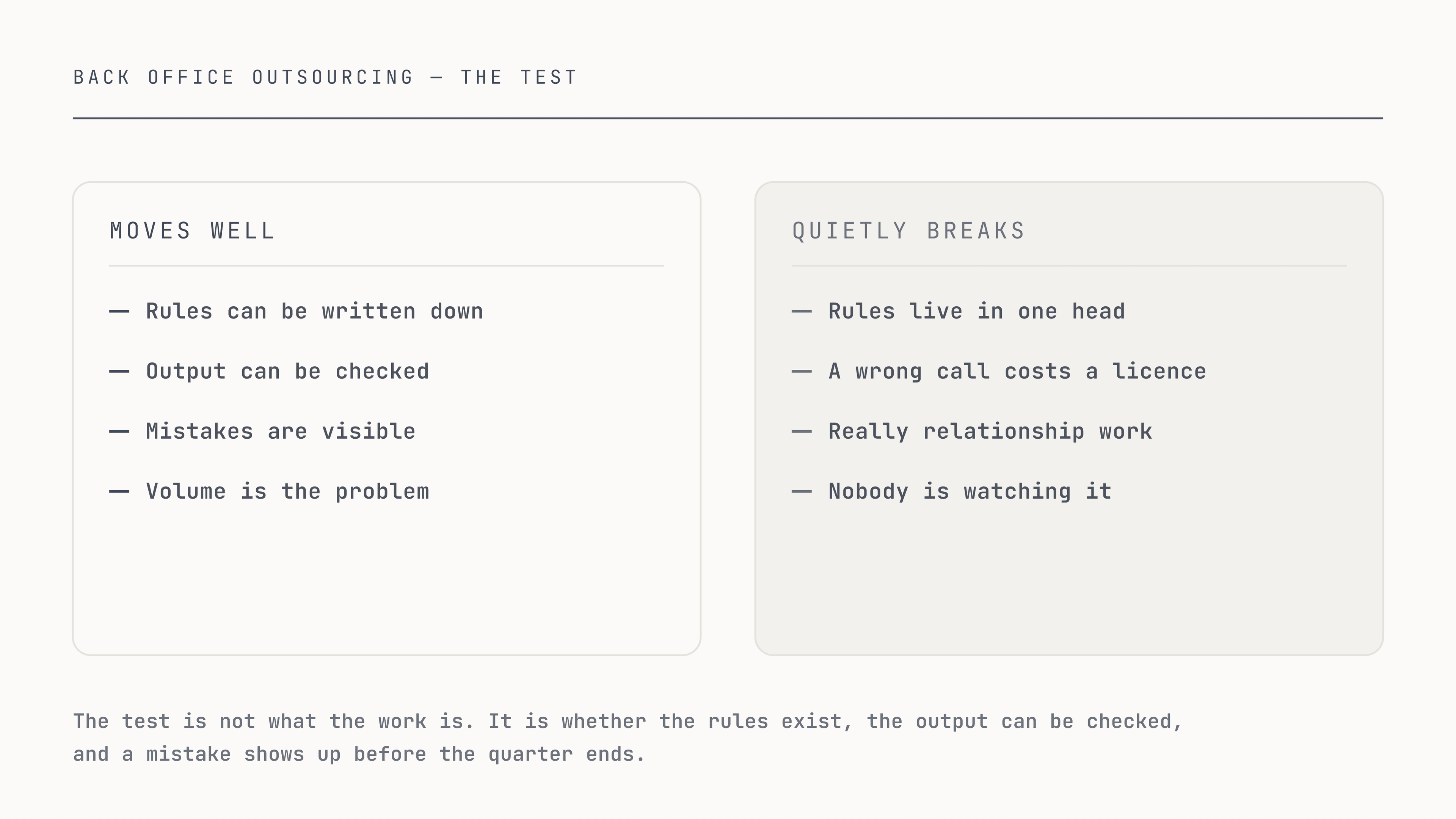
Work moves cleanly when three things are true: the rules can be written down, the output can be checked, and a mistake is visible rather than silent. On that test, most of the back office qualifies.
- Document and data work. Data entry outsourcing is the archetype — high volume, clear rules, a correct answer that exists. Modern desks run extraction first and put a person on everything below a confidence threshold, so the cost curve is not simply headcount.
- Order processing. Order taking across phone, chat and email, written straight into your system with stock validated as it goes. The rules are yours; the volume is the problem.
- Onboarding and verification. KYC outsourcing works offshore precisely because it is procedural: a documented policy, a defined evidence standard, an auditable decision. What must not move is the accountability, which stays with the regulated firm.
- Alert and exception review. Transaction monitoring is first-pass triage against a written risk policy. Most alerts clear on the first check; the value of an external desk is absorbing that volume so your analysts see only what matters.
- Administrative load. Inbox, calendar, CRM hygiene, research, reporting — the work a virtual assistant desk absorbs. Individually trivial, collectively a full-time job nobody was hired to do.
- Structured follow-up. B2B appointment setting and pipeline hygiene are back-office work wearing a sales badge: the discipline is systematic follow-up, not persuasion.
The functions that quietly break
The failure mode of back office outsourcing is almost never a dramatic collapse. It is a slow, unmeasured degradation in work nobody was watching, discovered a quarter late.
Three categories break more often than they work:
- Work with undocumented rules. If the correct answer lives in one person’s head, no provider can reproduce it. The honest sequence is to write the rules down first and outsource second — and if writing them down turns out to be impossible, that is the answer.
- Judgement calls with asymmetric cost. A wrong call that costs a customer relationship, a licence or a regulatory finding does not belong on a desk optimised for throughput, no matter whose desk it is.
- Work that is really relationship management. Named-account service, escalations from strategic customers, anything where the person on the other end expects to be known. Outsourcing this saves money and costs the account.
Why outsourced back office work slows down — and how to stop it
Enough people search for why back office outsourcing slows response times that it is worth answering directly rather than pretending it does not happen.
It happens for a specific reason, and the reason is not distance or timezone. It is that the work crossed a boundary without its escalation path crossing with it.
In-house, a stuck item gets resolved by someone standing up and asking. Outsourced, that same item has nowhere to go. It waits in a queue for an answer that has to travel through an account manager, and a five-minute question becomes a two-day one. Multiply by a few percent of daily volume and the average time-to-complete moves without any individual doing anything wrong.
The fix is structural and it should be in the contract, not in the pitch:
- A named escalation route from the desk to a decision-maker at your end, with a response window on your side as well as theirs.
- An exception rate reported weekly — the share of items that could not be completed under the documented rules. Rising exceptions are the leading indicator; slipping turnaround is the lagging one.
- Turnaround measured on the item, not on the shift. "Same day" means nothing if the item arrived at 5pm.
How to choose a provider — the questions that separate them
Every provider will tell you they have trained staff, quality assurance and a dedicated account manager. None of that distinguishes anyone. These do:
- "What is your exception rate on work like ours, and how is it reported?" A provider who has never measured this is telling you they manage by anecdote.
- "Who signs off a decision I would be answerable for?" For regulated work — onboarding, monitoring, anything supervised — the disposition must be a person’s and the reasoning must be reconstructable months later.
- "What happens in month eighteen when volume halves?" Contracts written only for growth get expensive precisely when you need them not to be.
- "Where is the work physically done, and under what contract?" For anything touching personal data this is not a curiosity. It determines whether you can put the provider in your outsourcing register — the fintech due-diligence position sets out what a regulated buyer should be asking for.
- "Can you show me the exit plan?" A provider who cannot describe how you leave has built a dependency, not a service.
What it costs, and the number that actually matters
Offshore back office services are usually quoted per seat per month, or per transaction for well-defined work. Seat pricing is simpler; transaction pricing aligns incentives better, because the provider only earns more by doing more work rather than by staffing more people.
The number worth watching is not the rate. It is cost per completed item, including the exceptions your own team ends up handling. A cheap seat that returns 15% of items unresolved is more expensive than a dearer one that returns 2% — and only one of those two numbers appears on the invoice.
This is also where automation changes the arithmetic. If document extraction handles the routine share and people handle everything below a confidence threshold, cost stops scaling one-to-one with volume. That only works when whoever builds the system is answerable for the queue it produces — which is why we do both halves, and why AI development and the desks are priced as one decision rather than two.
And if the front office is the real problem
Back office outsourcing is often the wrong first move. If your team is drowning, the volume is usually arriving through a channel a customer can see — a phone line nobody answers after five, an inbox with a two-day backlog, a chat widget that nobody staffs.
That is a different decision, with different failure modes, and it is covered by customer support outsourcing rather than by a back-office desk. Email support outsourcing and staffed phone coverage change what your customers experience; back office work changes what your team can get through. Both are worth doing. They are not interchangeable, and doing the second while the first is broken tends to hide the problem rather than fix it.