What customer support outsourcing actually covers
Customer support outsourcing means handing some or all of your inbound customer contact to an external team. In practice that is four channels and two tiers, and providers differ enormously in which of them they will actually take.
The channels are phone, chat, email and messaging. Most buyers start with one — usually the one that is currently on fire — and add the rest once the first works. Running them separately is common and is usually a mistake, because the same customer moves between them and expects to be recognised.
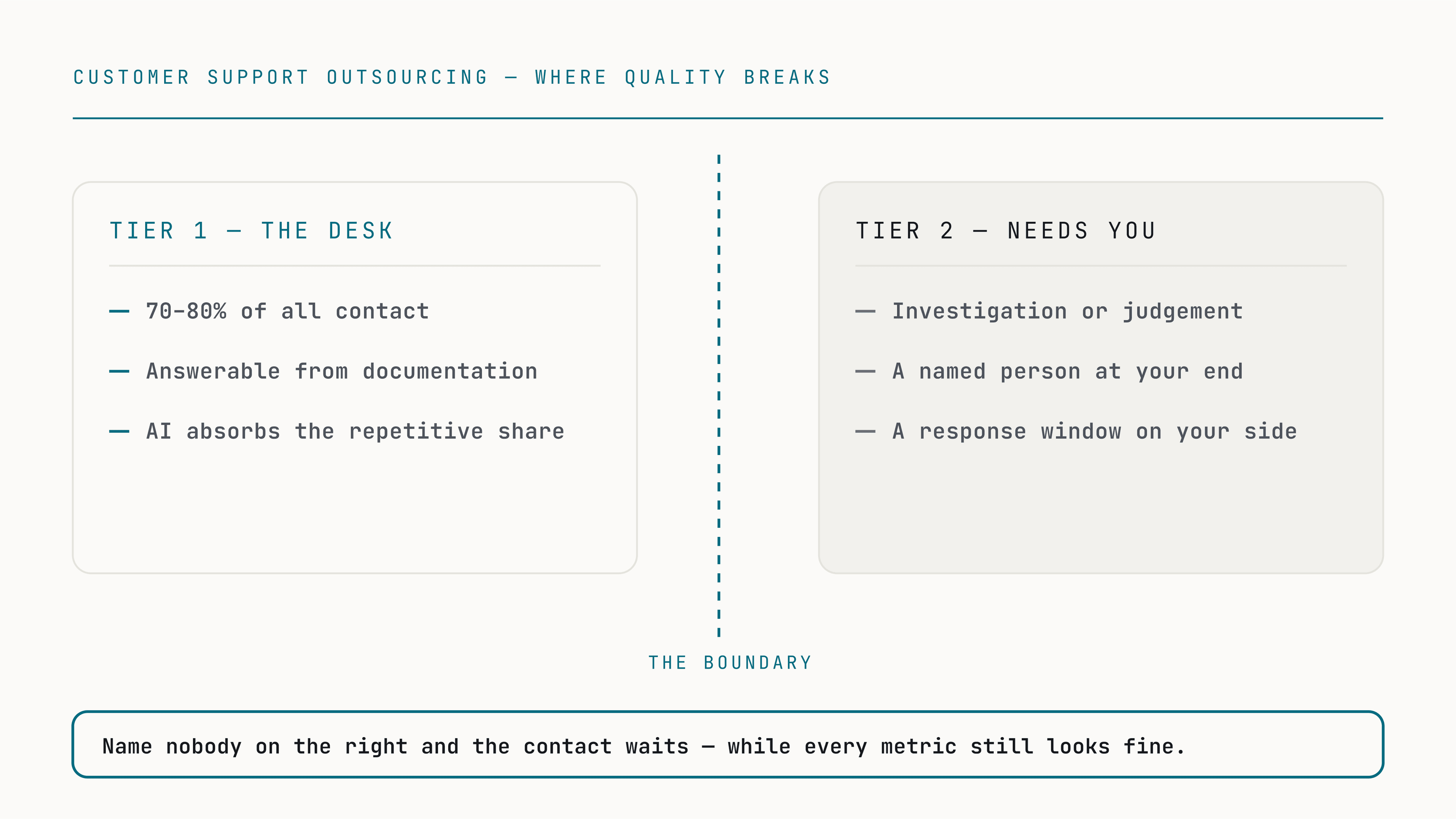
The tiers matter more. Tier 1 is everything answerable from documented knowledge: where is my order, how do I reset this, what does this charge mean. Tier 2 is everything requiring investigation, a system change, or a judgement call. Roughly 70–80% of contact volume is Tier 1 in most businesses, which is why outsourcing it is attractive — and why the boundary between the tiers is where the whole thing succeeds or fails.
Why quality drops — and it is not the accent
The fear people bring to this decision is that an outsourced agent will be worse than an in-house one. That is the wrong thing to worry about. A trained agent working from good documentation resolves a Tier 1 contact just as well from anywhere.
What actually breaks is the escalation path. In-house, an agent who cannot resolve something stands up and asks the person who can. That conversation takes ninety seconds and the customer never knows it happened. Outsourced, that same agent has no one to stand up and ask. The contact goes into a queue, waits for an account manager, waits for someone at your end to notice, and comes back two days later — or does not come back at all and the customer churns quietly.
This is why quality metrics on outsourced support often look fine while satisfaction falls. First-response time is measured and looks good. Resolution rate is measured and looks good. What nobody measures is the share of contacts that crossed the tier boundary and what happened to them after they did.
The three numbers that actually reveal it:
- Escalation rate — the share of contacts the desk could not close. If it is not reported weekly, it is not being managed.
- Time-to-resolution on escalated contacts specifically, measured separately from the overall average. The average hides them; they are a small share of volume and a large share of damage.
- Repeat contact rate — how often the same customer comes back about the same thing. This is the single best proxy for whether the first answer was actually an answer.
The tier boundary is a contract term, not a hope
Most outsourced support arrangements define what the desk handles. Very few define what happens at the edge of it, which is precisely where the cost lands.
A boundary that works has four things written down before anyone takes a call:
- A named person at your end who answers Tier 2 questions, with a response window on your side as well as the desk's. This is the part buyers resist and the part that determines the outcome.
- A default action for the unanswerable. When nobody at your end responds within the window, what does the agent do — hold, refund, escalate to a manager, tell the customer a timeframe? Undefined means improvised.
- A route back into documentation. Every escalation is a gap in the knowledge base. If resolved escalations do not get written up, the same contact escalates forever and the desk never gets cheaper.
- Authority limits in writing. What can the desk decide alone — a refund up to what value, a replacement under what conditions? Agents with no authority escalate everything; agents with unclear authority guess.
Which channel to move first
The honest answer is: the one where you are currently failing, not the one that is cheapest to move.
Phone is usually where the damage is, because an unanswered call is gone in seconds and leaves no record. If calls are ringing out, call center outsourcing or a simpler answering service fixes a measurable revenue leak rather than a comfort problem. If the gap is specifically evenings and weekends, after-hours answering is a narrower and much cheaper first step than full coverage.
Live chat support is the easiest channel to staff externally and the one where an AI layer absorbs the largest share, because chat questions repeat more than any other channel. Email support outsourcing is the most forgiving — asynchronous, so a two-hour handover gap costs nothing — which makes it a sensible first move if you want to test a provider before trusting them with the phone.
For businesses where the caller expects a receptionist rather than a support desk — clinics, firms, trades — a virtual receptionist is a different service to a support queue and should not be bought as one.
Where AI belongs, and where it does not
Enough people now search for how to choose AI agents for customer support outsourcing that it needs a straight answer rather than a sales pitch.
AI is genuinely good at the repetitive share — the same twenty questions that make up most of Tier 1. AI agents handling those well is the difference between a desk that scales with volume and one that scales with headcount. On the phone, AI voice agents can carry a first-line conversation and route properly.
What AI should not do is decide. A refund, a compliance disposition, an exception to policy — those need a person, not because a model cannot produce an answer, but because a wrong one is expensive and nobody can explain how it was reached.
The failure mode worth naming: a deflection layer tuned to reduce ticket volume rather than to resolve contacts. It reports beautifully. The tickets go down. What actually happened is that customers gave up, and giving up does not appear on the dashboard. If a provider quotes a deflection rate without a satisfaction number beside it, ask for the second number.
This is also the argument for buying both halves from the same place. When the company that built the automation also staffs the queue it produces, a badly tuned deflection costs them the escalation instead of costing you the customer. Ours is priced as one decision for that reason.
How to choose between customer support outsourcing companies
Every provider claims trained agents, quality assurance and 24/7 coverage. None of it separates them. These questions do:
- "What is your escalation rate on accounts like ours?" A provider who has not measured it manages by anecdote. One who quotes a suspiciously low number is either handling simple work or closing contacts that were not resolved.
- "Is the team dedicated or pooled, and what happens when someone leaves?" Neither answer is wrong. A pooled desk holds up under volume spikes and does not stop for annual leave; a dedicated team knows your product better. Providers who claim both are describing a pooled desk in dedicated language.
- "Who writes the knowledge base — you or us?" If the answer is you, the first three months are yours and the quote should reflect that. If it is them, ask to see one they have written.
- "Show me a QA scorecard from a real account." Redacted is fine. What matters is whether the criteria measure resolution or politeness. Politeness is easy to score and easy to hit while resolving nothing.
- "What does month eighteen look like if our volume halves?" Support volume is seasonal and shrinks when the product improves. A contract that only prices growth becomes expensive at exactly the wrong moment.
What outsourced customer support costs
Pricing comes in three shapes. Per seat is a monthly rate for a full-time agent — simplest, and best when volume is steady. Per contact aligns incentives better but needs a clear definition of what closes a contact. Per minute appears on phone work and rewards short calls, which is not the same as good ones.
The number to compare is not the seat rate. It is the fully loaded cost per resolved contact, including the time your own team spends on escalations. A desk at a low rate that escalates 20% of contacts is consuming your senior people; one at a higher rate escalating 5% may be cheaper in total and is certainly cheaper in attention.
Cost reduction in the range of 50–60% against in-house is the usual claim in this industry, ours included — and it is honest only with the basis stated: it compares against fully loaded local employment cost, and it does not hold in month one, when documentation and training absorb the difference. Any provider quoting a saving without naming the comparison is quoting a number they have not defined.
Back-office work prices differently again, because it is measured on completion rather than on conversation. If the queue you are worried about is documents and records rather than customers, back office outsourcing covers that decision separately.